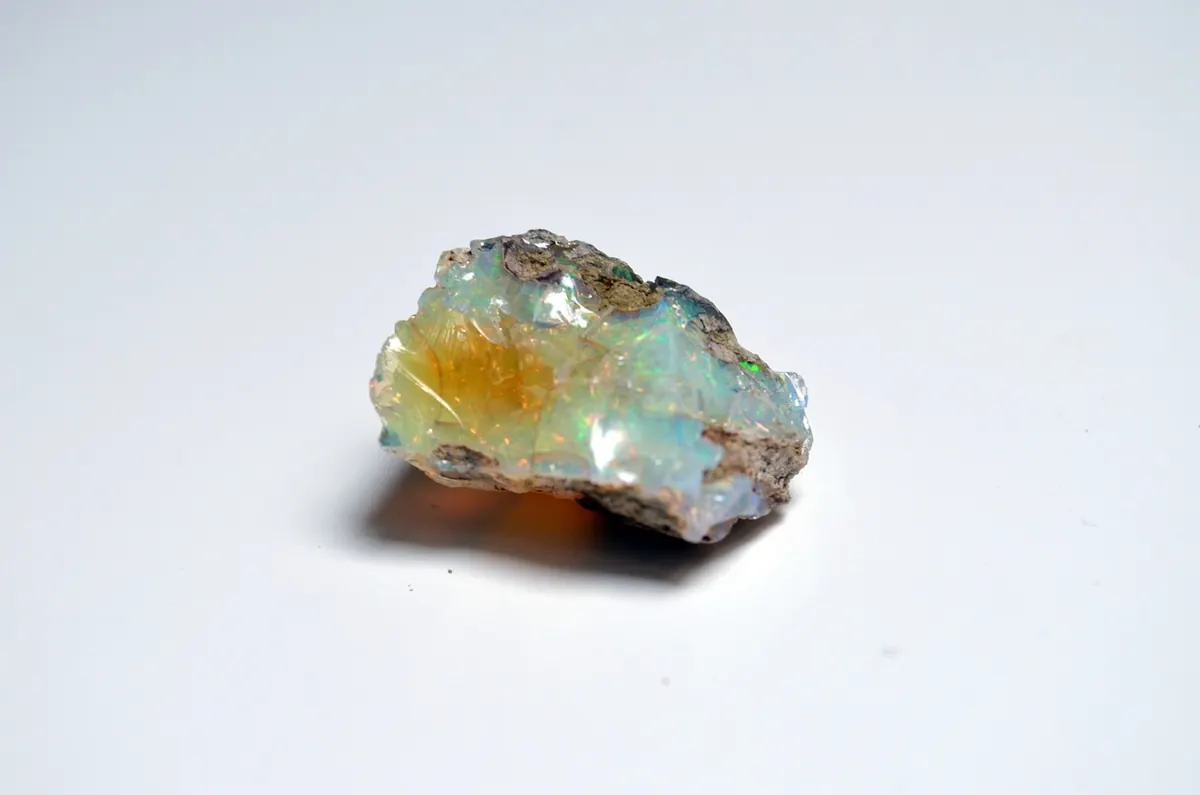
Opal has a reputation for being fragile, and like most reputations it is half true. The stone is softer than the gems most people are used to, and it will not shrug off the knocks that a sapphire ignores. But plenty of people wear opal rings every day for years without trouble, because they choose the setting sensibly and take the ring off before they dig in the garden. What follows is the plain version of what opal hardness means in practice, without the scare stories and without the sales talk.
What the Mohs scale measures, and what it does not
The Mohs scale ranks minerals by how well they resist being scratched, from talc at 1 to diamond at 10. It is a relative scale, not a linear one: the gap in scratch resistance between 9 and 10 is much larger than the gap between 5 and 6. More importantly, hardness is only one half of durability. The other half is toughness, which is how well a stone survives impact and pressure.
These two properties do not always travel together. Jade is not especially hard, but it is extraordinarily tough because of its interlocking grain. Diamond is the hardest substance we know and still splits cleanly along a cleavage plane if struck the wrong way. Opal is an amorphous form of hydrated silica, so it has no cleavage planes to split along. What it has instead is brittleness. It chips, it flakes at thin edges, and it does not like being knocked against a table leg.
So when someone says opal is soft, they mean two things at once: it scratches more easily than most gemstones, and it chips rather than deforms when it takes a hit. Both matter for daily wear, and they call for slightly different answers.
Where opal sits, in everyday terms
Most gem opal falls between 5.5 and 6.5 on the Mohs scale. Window glass is about 5.5. Quartz, which includes amethyst, citrine, and the grit in ordinary household dust, is 7. Everyday steel tools sit in the same range as opal or a little above it.
That last comparison is the one people underestimate. Dust often contains tiny quartz particles, and quartz is harder than opal. Wipe a dusty opal with a dry cloth and you can drag abrasive grit across the surface, slowly dulling the polish. Rinse the stone under lukewarm water first, then blot it dry with a soft cloth. This single habit does more for a well-loved opal than any special product.
It also helps to know what will not scratch opal. A fingernail is around 2.5. A copper coin is roughly 3. Fabric, wood, paper and most plastics are all well below the stone's range. The realistic dangers are quartz grit, steel, other jewellery, and hard surfaces like tile, granite and concrete.
Rings: the hardest-working piece of jewellery you own
A ring lives on a hand, and hands open doors, carry shopping, grip steering wheels and reach into pockets for keys. A ring worn daily on the dominant hand will meet more abrasive surfaces in a year than a necklace meets in a decade. None of that destroys an opal overnight, but it does add up.
The usual wear pattern is predictable. The polish on the dome dulls first, so the stone looks slightly less lively in flat indoor light. Then the girdle, the thin rim where the dome meets the setting, picks up tiny chips. A good jeweller can re-polish a solid opal, and small edge chips can sometimes be smoothed, but prevention is cheaper and keeps the stone original.
If you want an opal ring for regular wear, a few choices tilt the odds in your favour:
- Choose a bezel or flush setting over tall prongs, so metal takes the knocks instead of the stone's edge.
- Prefer a fuller, higher dome. A thin, flat-cut opal has less material to sacrifice before damage reaches the colour play.
- Wear it on the non-dominant hand when you can.
- Take it off for gardening, gym sessions, moving furniture, and heavy cleaning. Thirty seconds of effort, years of extra life.
Bracelets, bangles, and other high-contact pieces
Bracelets are arguably riskier than rings, because they swing. A wrist naturally finds desk edges, car doors and countertops, and a bangle makes contact with everything it passes. An opal-set bracelet is a beautiful thing, but expect edge wear over time and check the settings every few months for looseness.
If you wear jewellery constantly and want opal in the mix, pendants and earrings are the forgiving choice. They hang or sit still, rarely meet a hard surface, and a bezel-set opal pendant can comfortably become a piece you never take off.
Composite stones deserve a mention here. A doublet pairs a thin slice of opal with a domed cap, usually quartz or glass; a triplet adds a dark backing. The cap protects the opal layer and the assembly handles impact better than a solid stone of the same thinness. The trade-off is that the cap itself can scratch, and the glued joins dislike long soaks in water. Remove doublets and triplets before swimming or washing up.
Settings and cuts that protect a soft stone
Let metal take the hit
A bezel wraps a rim of metal around the stone's edge, which is exactly where chips start. A flush or gypsy setting sinks the opal level with the metal, protecting it further at the cost of some light. Prongs are fine for earrings and pendants, which rarely collide with anything, but on a ring they catch on knitwear, bend, and leave sharp edges near a brittle stone.
Respect the dome
Opal is normally cut en cabochon, with a rounded top, partly because that shape shows off the play of colour and partly because a dome spreads impact across a curve rather than concentrating it at a point. A shallow, thinly cut stone in a ring is a stone waiting for a bad afternoon. If you are buying for daily wear, ask for a cabochon with visible depth above the setting.
Care habits that add years
- Rinse before you wipe. Lukewarm water, fingertips only, then blot with a soft cloth. Skip paper towels, which can be surprisingly abrasive.
- Skip the ultrasonic and the steam cleaner. Both are standard for sapphire and diamond, and both are a poor idea for opal, especially for doublets, triplets and fracture-filled stones.
- Keep household chemicals away. Bleach, ammonia, chlorine and acetone offer nothing good to a hydrated silica stone.
- Store it apart. A soft pouch of its own, away from harder jewellery that could scratch it in a drawer.
- Avoid sudden temperature swings. Do not move an opal from a hot car into cold water, or the reverse.
- Be sceptical of the old oil-and-water advice. Keeping opals submerged or oiled is contested, and it can discolour some stones and loosen the joins in composites. Sensible storage in a moderate, not bone-dry environment is enough.
- Have settings checked once a year. A jeweller can tighten a loose prong or spot a worn bezel before the stone pays for it.
Is an opal right for your everyday?
Ask yourself how you actually use your hands, not how you would like to. If you type for a living and take rings off at the sink, a solid opal ring is a reasonable daily companion. If you rock climb, garden, or work with your hands all day, an opal pendant or a pair of studs will give you far more pleasure per year of wear than a ring you keep leaving at home.
There is no rule that says fine opal must live in a box. It simply rewards a little attention: a protective setting, a rinse before a wipe, and the habit of taking it off before the rough jobs. Handle it that way and the stone will keep its fire for decades.
Photo: Varga / Pixabay