An opal's play-of-colour is a moving target. Tilt the stone a few degrees and a green flash folds into blue; turn it again and the face goes quiet. That restlessness is what makes opal beautiful, and it is also why first-time buyers misjudge one — in a shop, and even more often from a photograph.
Reading those flashes is a skill, not a talent. It takes decent light, a few minutes of patience, and a rough idea of what to look for.
Separate the body colour from the play-of-colour
Two things are happening on the surface at once, and beginners tend to blend them together.
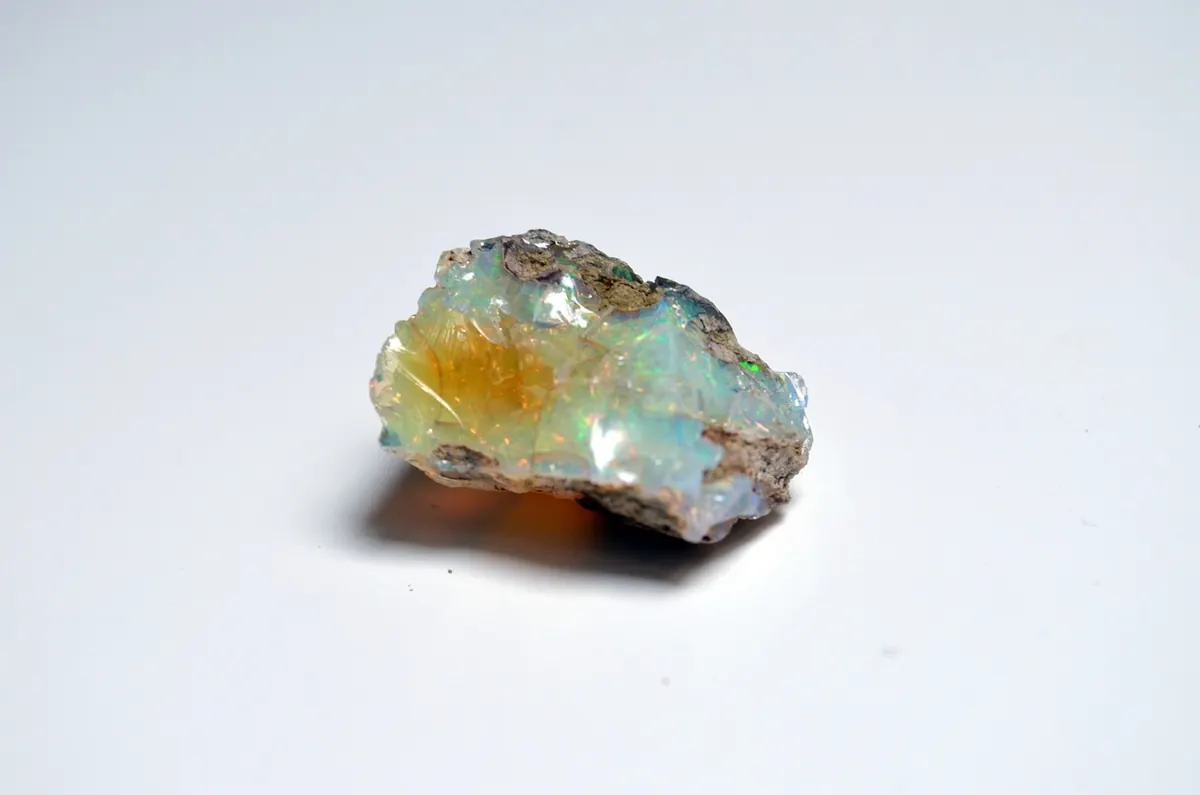
The first is body colour: the overall tone of the stone. A black opal reads dark grey to jet, a white opal milky, a crystal opal translucent enough to see through. The second is play-of-colour — the patches of spectral colour that appear, shift and vanish as the angle changes. Those flashes come from microscopic spheres of silica stacked in regular layers inside the stone, which bend light into rainbow colours.
A quick test separates the two. Hold the opal at arm's length and look at it without moving: what you see is mostly body colour. Now tilt it slowly. Anything that answers back — green, red, a bar of blue sliding across the face — is play-of-colour.
Some material has almost none. That is potch, opal without the colour structure. It is not a defect, but you should know which one you are looking at.
Set up the light before you judge anything
Most disappointing opal purchases start with bad lighting, and it cuts both ways: harsh light flatters a dull stone, and poor light kills a good one.
Start near a window in indirect daylight, on an overcast day if you can. Direct sun is too intense and will make even a modest stone throw colour. Put the opal on a neutral surface — plain white paper for light stones, mid-grey cloth for dark ones. Bright surfaces bounce their own tints into the stone, and so does a red shirt. Black paper deepens a dark opal's background and makes the flashes look stronger, which is exactly why jewellers use it; look at both and see what changes.
Then ask whether the colour comes out of the stone or sits on top of it. Real play-of-colour seems to come from just beneath the surface, and it shifts as you move.
The tilt test: how to move the stone
Give yourself a repeatable method. An honest assessment comes from many angles, not one flattering position.
- Hold the stone between thumb and forefinger, about 25–30 cm from your eyes.
- Tilt it slowly through a full arc, left to right, then top to bottom. Slow matters — quick movement makes every stone look lively.
- Notice where the colour appears and, more importantly, where it disappears. Every opal has dead angles.
- Rotate the stone a quarter turn and repeat. You are mapping the whole face, not just the best corner.
- Count the positions that produced a bright flash. Two out of ten is a very different stone from eight out of ten.
Read brightness, coverage and pattern
Once you can see the colour reliably, three qualities decide most of what you are looking at.
Brightness. Ask how the flashes read in the room: faint and ghostly, clearly visible, or bright enough to catch your eye from across a table. Brightness is the quality buyers underestimate most, because a large dull flash photographs well and underwhelms in the hand.
Coverage. This is simply how much of the face shows play-of-colour at any given moment. A stone lit up across most of its face behaves very differently from one with a single bright patch near the edge.
Pattern. The shape the colour takes has names worth knowing.
- Harlequin: blocky, mosaic-like patches with sharp edges; uncommon and much admired.
- Broad flash: large sweeping sheets of colour that flare and disappear.
- Pinfire: many tiny points of colour, like sparks.
- Rolling flash: a band of colour that rolls across the stone as it turns.
- Chinese writing: thin, script-like strokes of colour.
None of these is automatically better than the others — plenty of people prefer a lively pinfire to a stiff harlequin. But as a general rule, larger patterns with clean, distinct edges are harder to find than small scattered ones.
Try several light sources, and notice what each one lies about
No opal should be judged under a single lamp. Take the same stone into three or four conditions and watch what survives.
Daylight outdoors is the fairest test and often the most generous. Warm incandescent light deepens reds and oranges and can make a stone feel cosier than it is; cool white LED light pushes blues and greens but flattens the warm colours. A phone torch held at a low angle is excellent for showing whether the colour sits deep in the stone or only at the surface, and for spotting fine crazing or potch lines you would otherwise miss.
Then there are the conditions built to sell. Display lamps are usually bright, cool, and set against dark velvet — a genuinely effective combination for black opal. Enjoy it, then ask to see the stone away from the case, in ordinary room light, before you decide.
A useful rule: if an opal only performs under one specific light, that tells you something. A good stone stays interesting when the lighting is indifferent.
What a screen takes away
Photographs and short videos are where most beginner mistakes happen, and it is rarely the seller's fault. A camera records one angle out of the hundreds your eye would pass through in ten seconds. Video helps, but you are still seeing a chosen path across the stone.
So read listings for the unglamorous details: whether the colour is described as covering the face, whether the video shows the stone turning dull, whether the light source is stated. When the stone arrives, run the tilt test in ordinary daylight before you form an opinion.
A five-minute routine before you buy
Here is the whole method, compressed.
- Neutral background, indirect daylight. Look at the still stone first.
- Tilt slowly through a full arc, then rotate a quarter turn and repeat.
- Count how many positions give a bright flash.
- Repeat under one warm lamp and one cool one.
- Find the worst angle and study it deliberately.
If the stone still holds your attention after that, you are looking at something worth considering. If the colour only appears from one perfect angle, you have learned something useful about the price as well. And for any significant purchase, buy from a seller with a clear return policy — the best lighting test in the world is a few quiet days with the opal in your own home.
Photo: Camera-man / Pixabay